Project documentation
Collection systems, Machine traits, staking mechanics, economic design, utility, and roadmap.
Token — $RCHINES & Economic Sustainability
Current baseline model: $RCHINES is farmed by staking Machines. Emission is tied to fixed NFT trait multipliers, permanent Power profiles, and scheduled maintenance sinks. The exploratory two-layer model below could later replace direct farming with non-transferable Work Credits before any liquid-token distribution.
Emissions follow the formula:
Daily Yield = Base Rate × Rarity × Network × Type × Power × Condition
Official Base Rate
The official Base Rate is 1.00 $RCHINES for each complete 24-hour farming period. It represents the output of the baseline configuration below before any premium multiplier is applied.
| Reference Attribute | Baseline Value | Multiplier |
|---|---|---|
| Base Rate | One complete 24-hour farming period | 1.00 $RCHINES |
| Rarity | Common | 1.0× |
| Network | None | 1.0× |
| Type | Machine | 1.0× |
| Power | Standard | 1.0× |
| Condition | Factory New | 1.0× |
1.00 × 1.0 × 1.0 × 1.0 × 1.0 × 1.0 = 1.00 $RCHINES per 24 hours
Rewards accrue proportionally over time. For example, the baseline configuration accrues 0.50 $RCHINES after 12 hours. A Factory New Legendary Bitcoin Station running Overclocked produces 4.74 $RCHINES per 24 hours: 1.00 × 3.0 × 1.10 × 1.15 × 1.25 × 1.00 = 4.74375.
Creator earnings actually received from eligible secondary-market sales follow the current treasury policy: 65% Liquidity Reserve, 25% Development & Operations, and 10% Collection Treasury. Marketplace support and enforcement may vary. Full capital allocation, treasury governance, and liquidity policy live on the dedicated Tokenomics page.
Possible Future Utility — Robinchines Empire
A future utility layer could take the form of a simple idle farming and management game inspired by classic incremental games. Players would begin with a small scrapyard or garage and gradually build a larger machine-based operation, visually progressing through industrial land, vehicles, factories, cities, space infrastructure, and eventually property on the Moon.
Two-Layer Economic Loop
| Layer | Purpose | Transferability | Primary Sink |
|---|---|---|---|
Work CreditswRCHINES (provisional) |
Resource accrued through NFT staking and used inside the future game. | Intended to be non-transferable and not independently traded. | Land, buildings, vehicles, research, maintenance, expansion, and prestige progression. |
| $RCHINES | Official liquid ecosystem token. | Transferable ERC-20 token used across the Robinchines ecosystem. | Scheduled maintenance, premium utility, crafting, customization, and other approved token burns. |
The strategic choice would be whether to spend earned Work Credits on game progression or submit part of them for a controlled conversion into $RCHINES. Work Credits spent in the game would be permanently destroyed, reducing the amount that could later become liquid token supply.
Example Progression
- Scrapyard: first machine, workbench, and starter plot.
- Garage: repair bays, parts, mechanics, and utility vehicles.
- Industrial Farm: additional machine slots, power systems, and warehouses.
- City Network: factories, logistics, transportation, and research facilities.
- Corporation: advanced production networks and large-scale infrastructure.
- Space Expansion: rockets, orbital facilities, and high-prestige Moon property.
Purchases should visibly transform the player's property. Progression must include recurring sinks — such as maintenance, research seasons, fuel, temporary missions, and prestige resets — because permanent upgrades alone eventually stop consuming resources.
Economic Safeguards to Validate
- Work Credits should be accounting units rather than a second freely traded token.
- Conversion should draw from a pre-funded, capped reward vault instead of enabling unlimited minting.
- Each season should publish a conversion budget and rate before it begins.
- Upgrade returns should diminish at higher levels to prevent uncontrolled compounding.
- The game should primarily consume resources and award progression, cosmetics, or bounded utility rather than create another unlimited token faucet.
- Chance-based token spending and guaranteed-profit language should be avoided.
Economic distinction: destroying Work Credits is anti-inflationary because it reduces potential future $RCHINES distribution. Only burning circulating $RCHINES directly reduces the official token's total supply.
Traits Architecture & Staking Mechanics
Each NFT consists of 6 permanent functional traits that define its identity and farming efficiency:
| Trait | Values / Options | Impact / Multiplier Mechanics |
|---|---|---|
| Machine | Alpha Drops, Arbitrage Snacks, Bitcoin Station, Coin Vendor, etc. | Visual identity and rarity tier assignment. |
| Rarity | Common (1.00×), Uncommon (1.20×), Rare (1.60×), Epic (2.20×), Legendary (3.00×) | Primary collection multiplier. This is fixed in the NFT metadata. |
| Type | Machine (1.00×), Station (1.15×) | Stations receive a 15% yield premium over standard Machines. |
| Network | None (1.00×), Bitcoin (1.10×), Ethereum (1.10×), Robinhood (1.10×) | All three named networks receive the same 10% premium. |
| Power | Eco (0.85×), Standard (1.00×), Overclocked (1.25×) | Permanent operating profile. Power changes output and scheduled maintenance cost. |
| Condition | Factory New (1.00×), Used (0.95×), Worn (0.90×), Damaged (0.80×) | Permanent NFT trait. It never degrades or changes, but affects yield, continuous farming limit, and maintenance-cost multiplier. |
Power Profiles
Power is a permanent NFT trait. It defines whether that Machine favors lower upkeep, balanced operation, or maximum output with a higher maintenance cost. There is no random breakdown mechanic or mutable operational trait.
| Power Mode | Yield Multiplier | Maintenance-Cost Multiplier | Operating Profile |
|---|---|---|---|
| Eco | |||
| Standard | |||
| Overclocked |
Power cannot be changed or rerolled. Owners choose a farming strategy through the Machines they decide to stake.
Fixed Condition Rules
Condition represents the machine's permanent build grade, not live wear. Maintenance never upgrades, downgrades, or rerolls Condition.
| Condition | Yield Multiplier | Continuous Farm Limit | Maintenance-Cost Multiplier |
|---|---|---|---|
| Factory New | 1.00× | 7 days | 1.00× |
| Used | 0.95× | 5 days | 1.15× |
| Worn | 0.90× | 3 days | 1.35× |
| Damaged | 0.80× | 1 day | 1.60× |
A continuous farm limit defines how long a machine may produce rewards before scheduled maintenance is required. Once the deadline is reached, additional rewards stop accruing until the maintenance fee is paid. Nothing changes in the NFT metadata.
Simplified Staking State
The NFT itself contains only the six permanent traits above. The staking contract records only farming-cycle timestamps, accrued rewards, and the next maintenance deadline. The deadline follows the token and is not cleared by unstaking, preventing a free reset through repeated stake and unstake transactions.
Wallet Connection & User Safety
Robinchines discovers compatible injected EVM wallets using EIP-6963, allowing users with multiple extensions — such as MetaMask and Rabby — to explicitly choose which provider they want to use.
- The user selects connect wallet.
- Robinchines displays the compatible wallet extensions detected in the browser.
- The user chooses one wallet. Only that provider receives the connection request.
- The selected wallet may request permission to share the user's public address.
Legacy window.ethereum discovery is retained only as a fallback for wallets that do not yet announce themselves through EIP-6963. The application never chooses between multiple modern providers without user input.
Rarity & supply — locked
Distribution follows a standard 50/30/15/4/1% curve across 3,333 units. Full rarity breakdown lives in the "how it works" section and is mirrored here for reference.
Mint Allocation
| Phase | NFT Allocation | Eligible Wallets / Spots | Wallet Limit | Access |
|---|---|---|---|---|
| Team Treasury | 133 | Project treasury | Reserved | Team reserve |
| Guaranteed Allowlist | 2,000 | 1,000 GTD spots | 2 NFTs | Guaranteed during its window |
| Community & Collabs | 1,000 | 625 eligible spots | 2 NFTs | FCFS · 25% controlled over-allocation |
| Public Mint | 200 | ∞ | 1 NFT | FCFS |
| Total Supply | 3,333 | — | — | Free mint |
Unused Guaranteed Allowlist allocation rolls into Community & Collabs. The Public allocation remains fixed at 200 NFTs; unused Community supply may reopen in an additional Community window instead of increasing the Public pool. A wallet eligible for both GTD and Community may mint up to two NFTs in each phase.
Roadmap
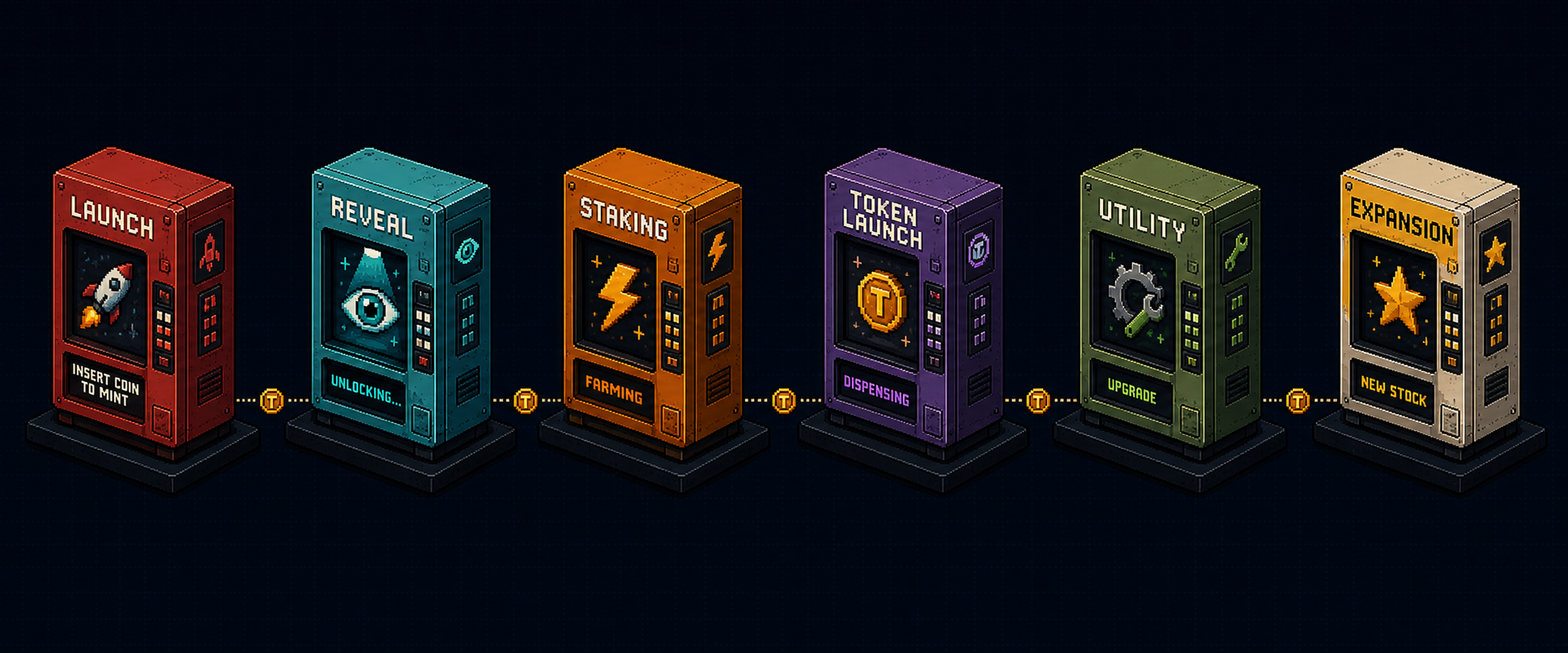
Public mint of all 3,333 machines. Metadata stays blind at mint — art and rarity are not visible yet. Needs: mint contract, mint site, whitelist logic, fair distribution check across rarity tiers.
Metadata unlocks — real art and rarity tier become visible per machine. Needs: reveal mechanism (delayed or randomized), rarity tiers confirmed on-chain, ranking page or explorer link.
Staking opens — machines start farming $RCHINES based on rarity and power. Needs: staking contract deployed, dashboard connected to it (currently mocked), anti-abuse rules (cooldowns, exit fees if any).
$RCHINES goes live — either converts accrued staking points or the token is already live and staking pays it directly. Needs: emission rate finalized, initial liquidity, DEX listing on Robinhood Chain.
Potential utility under exploration: an incremental management game where Work Credits are burned on land, buildings, vehicles, research, maintenance, and long-term progression. Conversion into $RCHINES would require a capped seasonal reward model. Concept documented; implementation is not committed.
New collections, partnerships, governance. Needs: nothing yet — this is post-launch, revisit once utility is live and stable.